Quotes From the Head of the Federal Arts Administration the New Deal
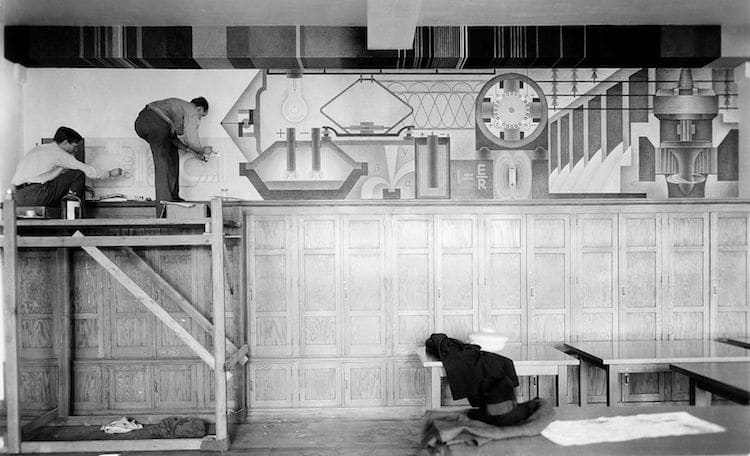
Photograph of artist Eric Mose on scaffold with mural "Ability" at Samuel Gompers Industrial High School for Boys, Bronx, New York (Photo: Wikimedia Commons [Public Domain])
"I pledge y'all, I pledge myself to a new deal for the American people," he proclaimed in his acceptance spoken communication at the Democratic National Convention in 1932. Four months later on, FDR would win the election past a landslide, and by 1933, he would launch his New Deal, a series of policies and programs intended to put the land on a streamlined path toward relief, reform, and recovery. With an emphasis on employment, the New Deal's primary goal was to put people to work, whether through low-involvement loans to farmers, large-calibration construction assignments, or even a creative Federal Art Project.
The Federal Art Project
On August 29, 1935, FDR enacted the Federal Art Project. Funded by the Emergency Relief Appropriation Act of 1935 and directed past former curator Holger Cahill, this crucial initiative was part of Federal Project Number Ane, a drove of projects (the Federal Music Project, the Federal Theatre Project, the Federal Writers' Project, and the Historical Records Survey) created with the country's fine art and culture sector in mind. Federal Project Number One, in plough, was part of the Works Progress Administration (WPA), a New Deal agency that recruited over eight one thousand thousand people to work on public projects.Art
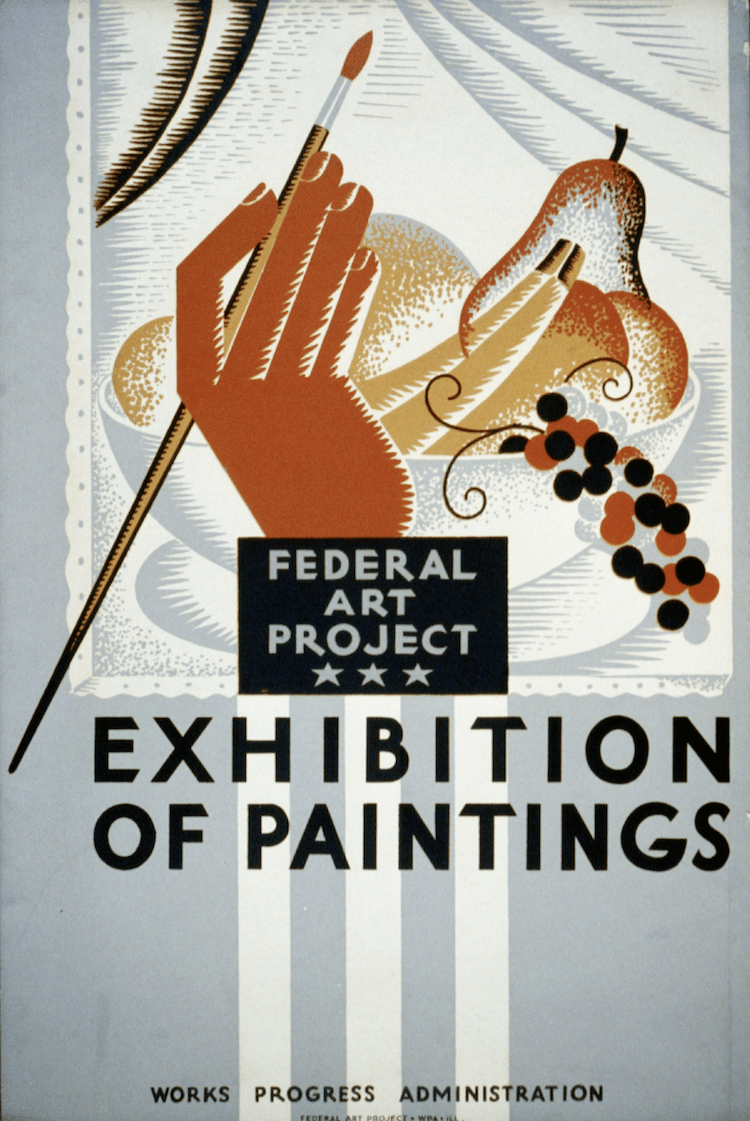
"Exhibition of Paintings" Poster, ca. 1936-1941 (Photo: Wikimedia Eatables [Public Domain])
The Federal Art Project, all the same, focused on enlisting out-of-piece of work artists to produce graphic posters, documentary photographs, large-calibration sculptures, modernist murals, and other works of art (namely for municipal and public buildings, only too for theaters, museums, and other arts organizations). It also called for customs art centers to popular up beyond the country, serving as exhibition spaces, educational institutions, and as a much-needed ways of making art accessible to all.
"I, likewise, accept a dream," FDR said, "to testify people in the out of the style places, some of whom are not only in small villages but in corners of New York Metropolis—something they cannot get from betwixt the covers of books—some real paintings and prints and etchings and some existent music."
Artists
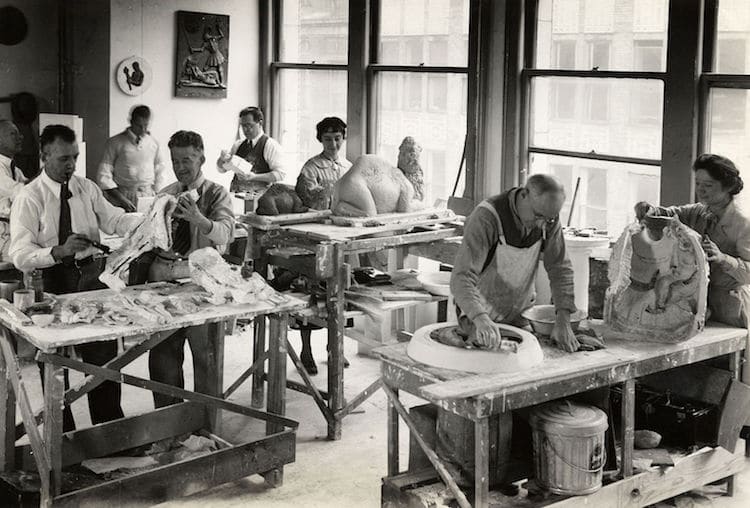
Sculpture workshop in New York sponsored by the Federal Fine art Project, C. 1940 (Photograph: Wikimedia Eatables [Public Domain])
What prepare the Federal Art Project apart from these initiatives, nevertheless, is that it employed artists of all skill levels and backgrounds. "The organization of the Project has proceeded on the principle that it is not the lonely genius just a sound general movement which maintains art equally a vital, functioning function of any cultural scheme," Cahill explained in 1936. "Art is not a thing of rare, occasional masterpieces."
This inclusive approach to employment proved successful. By the stop of its get-go yr, the Federal Art Project employed over 5,000 artists. By 1943, this number doubled, culminating in hundreds of thousands of artworks.
Tape numbers of employment and high quantities of output, however, were not the merely positive outcomes offered past Cahill's hiring practices. With little focus on upholding traditional notions of talent, the Federal Art Project inadvertently fostered some of mod art'due south most groundbreaking artists. In 1940, African American painter Jacob Lawrence would break boundaries with his colorful Migration Serial, while Willem de Kooning, Lee Krasner, Jackson Pollock, and Marking Rothko would found the Abstract Expressionist movement just a few years later.
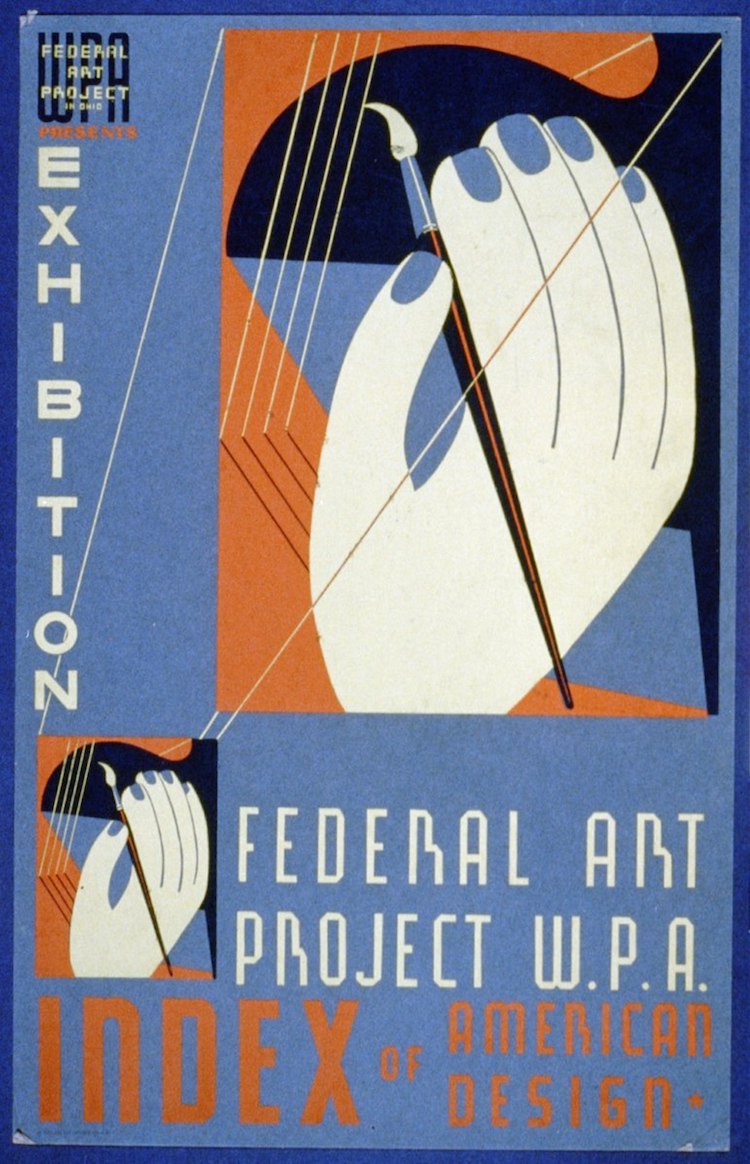
Poster for Federal Art Project exhibition of "Index of American Design," ca. 1936-1938 (Photo: Wikimedia Eatables [Public Domain])
"As nosotros report the drawings of the Index of American Design we realize that the hands that made the first two hundred years of this country's material culture expressed something more than untutored creative instinct and the rude vigor of a frontier civilization," Cahill explained. "The Index, in bringing together thousands of particulars from diverse sections of the country, tells the story of American manus skills and traces intelligible patterns within that story."
The Projection'due south Legacy
The Federal Fine art Projection continued employing artists until 1943—four years after the termination of Federal Project Number Ane and the terminate of the Neat Low. At its conclusion, Holger Cahill was yet director, having overseen the impressive completion of roughly 2,500 murals (many of which all the same adorn the walls of public buildings), xviii,000 sculptures, 108,000 paintings, 22,000 plates for the Index of American Design, and countless ephemera.
While these works are considered federal holding, many of them have seemingly disappeared, whether unaccounted for in not-federal repositories or simply lost. Since 2001, notwithstanding, the U.S. General Services Administration has been diligently working to track down whatever misplaced or missing works, taking inventory and compiling a readily available resource for "museum professionals, the academic community, art conservators, and the public at large." So far, the agency has recovered and cataloged xx,000 irreplaceable pieces, culminating in a legacy that is stronger than ever before.
Related Manufactures:
The Story Behind the Iconic 'Migrant Female parent' Photo that Defined the Keen Depression
How African American Fine art and Culture Blossomed During the Harlem Renaissance
How Diego Rivera Shaped Mexican Muralism, a 50-Twelvemonth Movement Sparked by the Revolution
9 Abstract Artists Who Changed the Way Nosotros Wait at Painting
Precisionism: The Modern American Fashion Sparked past Industrialization
Source: https://mymodernmet.com/wpa-federal-art-project/

Post a Comment for "Quotes From the Head of the Federal Arts Administration the New Deal"